
Cagrilintide
Long-acting amylin analog investigated for appetite regulation and weight management, often paired with GLP-1 agonists.
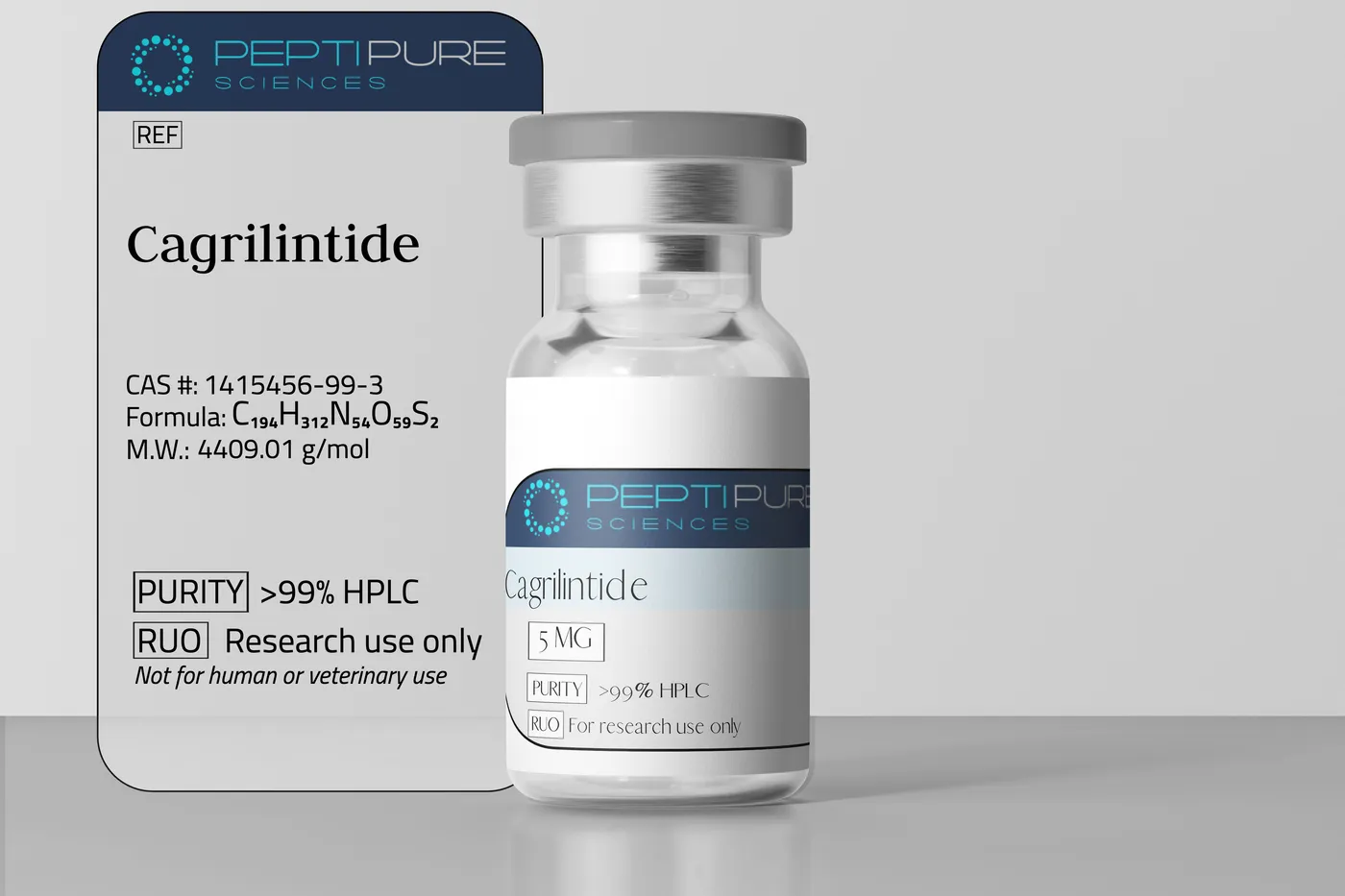
Research overview
Cagrilintide is an investigational, long-acting amylin analogue. Amylin is a hormone naturally produced in the pancreas and co-secreted with insulin following a meal. It plays a role in glucose regulation and appetite control.
The mechanism of action for Cagrilintide involves mimicking native amylin. It acts on receptors in the brain to induce satiety (a feeling of fullness) and slows the rate of gastric emptying. These actions are understood to contribute to a reduction in overall caloric intake.
Cagrilintide is being clinically evaluated for its application in weight management. Research is assessing its effects both as a standalone therapy and in a fixed-dose combination with a GLP-1 receptor agonist, semaglutide (this combination is known as CagriSema).
Peer-Reviewed Research (PubMed)
Selected landmark / highly-cited studies indexed on PubMed.
- 1.
- 2.Semaglutide 2.4 mg once weekly in combination with cagrilintide 2.4 mg once weekly (CagriSema) in adults with overweight or obesityEnebo LB, et al. — The Lancet, 2021
- 3.Discovery of the long-acting amylin analogue cagrilintideKruse T, et al. — Journal of Medicinal Chemistry, 2021
Studied benefits
- Activates amylin and calcitonin receptors
- Suppresses appetite and slows gastric emptying
- Synergistic effect with semaglutide (CagriSema)
- Once-weekly administration profile

Trusted U.S. research-peptide suppliers
We source and benchmark against established U.S.-based research-peptide manufacturers and distributors. Each supplier below operates under cGMP-aligned synthesis with documented CoA, HPLC, and mass-spec validation for research use only.
Logos are property of their respective owners and shown for reference only. Listing does not imply endorsement or an exclusive supply relationship.
Inquire about Cagrilintide
Share your research context so our team can recommend the right purity grade, documentation, and quantity. A scientific contact responds personally.
Related peptides
Modified hGH fragment (176–191) studied for fat metabolism without affecting glucose or IGF-1.
C-terminal hGH fragment studied for fat-loss effects without growth or insulin-axis impact.
Dual GLP-1 / glucagon receptor agonist investigated for metabolic and weight outcomes.