
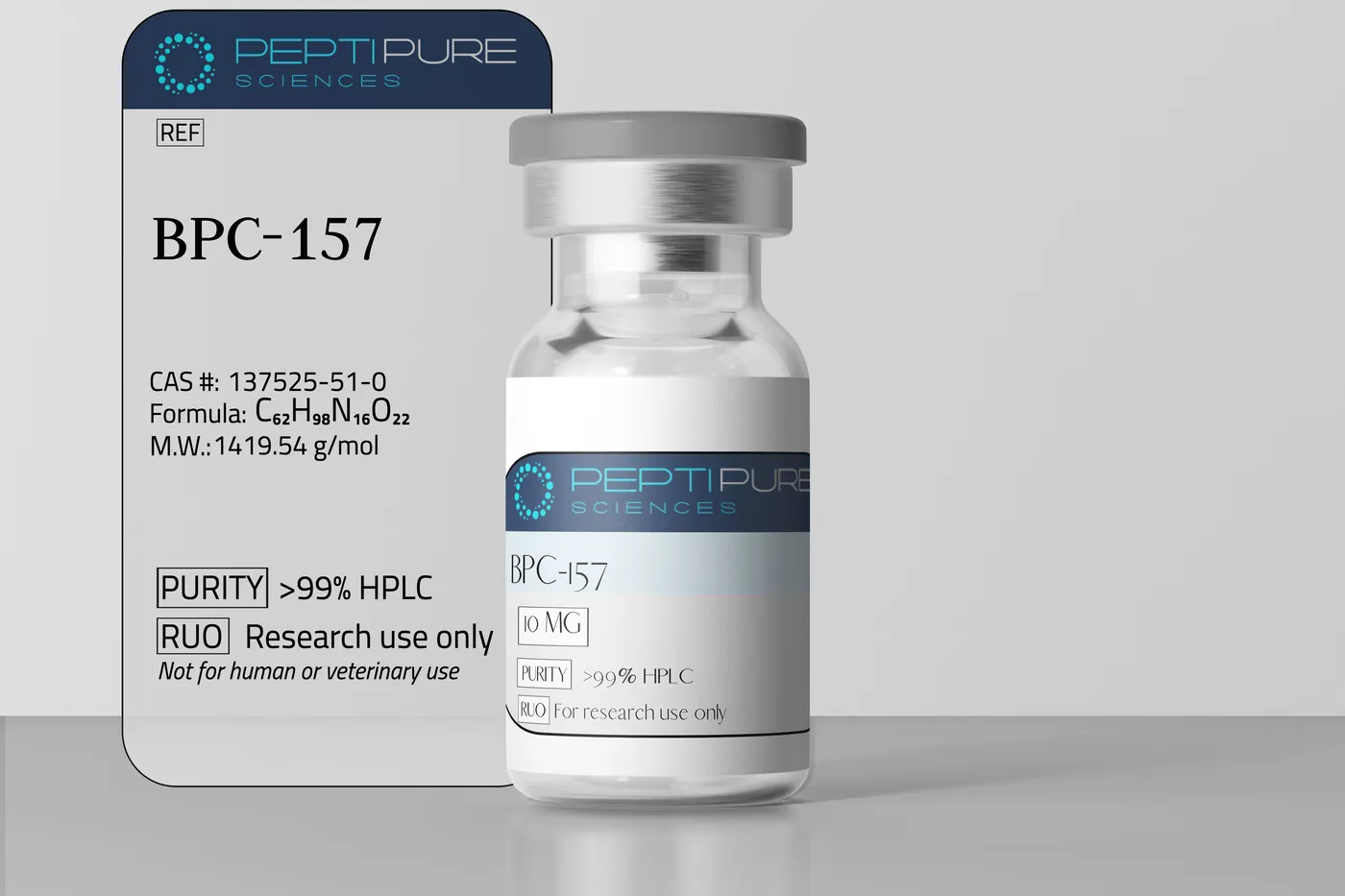
BPC-157
Body Protection Compound studied for accelerated tissue repair, gut integrity, and tendon recovery.
Research overview
BPC-157, a synthetic pentadecapeptide, is the subject of extensive preclinical research for its effects on the repair of various injuries, particularly those affecting musculoskeletal tissues.
Focus on Tendon and Ligament Injuries: A significant portion of the research on BPC-157 has centered on tendinopathies (injuries to tendons) and ligament damage. These tissues are known for their poor blood supply, which often leads to slow and incomplete healing. In animal models, BPC-157 has been observed to accelerate the healing of transected Achilles tendons and medically-induced ligament injuries. The repaired tissues in these studies often exhibit improved structural organization and biomechanical strength compared to untreated control groups.
Muscle and Bone Injuries: Research also extends to various forms of muscle injury, including direct contusions (crush injuries), transections (cuts), and recovery from surgical procedures in animal models. Studies suggest that BPC-157 can mitigate the negative effects of corticosteroids, which are known to impair muscle healing. While less emphasized, some research has explored its potential to support the healing of bone defects, suggesting a comprehensive role in musculoskeletal recovery.
Underlying Mechanisms of Action: The therapeutic effects of BPC-157 in injury repair are believed to be driven by several key mechanisms. Angiogenesis: BPC-157 has been shown to promote the formation of new blood vessels by upregulating Vascular Endothelial Growth Factor (VEGF), a key signaling protein that stimulates the growth of blood vessels into damaged tissue. Collagen Synthesis and Organization: the peptide is reported to influence the production and organization of collagen by promoting the migration and activity of fibroblasts. Modulation of Growth Factor Receptors: some evidence suggests BPC-157 can increase the expression of growth hormone receptors on fibroblasts, amplifying the natural healing cascade.
It is crucial to note that the vast majority of this research has been conducted in cell cultures and animal models (primarily rodents). While these findings are promising, comprehensive clinical trials are needed to validate the efficacy and safety of BPC-157 for treating injuries in humans.
Peer-Reviewed Research (PubMed)
Selected landmark / highly-cited studies indexed on PubMed.
- 1.Stable gastric pentadecapeptide BPC 157: novel therapy in gastrointestinal tractSikiric P, et al. — Current Pharmaceutical Design, 2011
- 2.Brain-gut axis and pentadecapeptide BPC 157: theoretical and practical implicationsSikiric P, et al. — Current Neuropharmacology, 2016
- 3.Pentadecapeptide BPC 157 enhances the growth hormone receptor expression in tendon fibroblastsChang CH, et al. — Molecules, 2014
Studied benefits
- Promotes tendon and ligament healing
- Supports GI lining repair
- Reduces inflammation in injured tissues
- May aid neurological recovery
Trusted U.S. research-peptide suppliers
We source and benchmark against established U.S.-based research-peptide manufacturers and distributors. Each supplier below operates under cGMP-aligned synthesis with documented CoA, HPLC, and mass-spec validation for research use only.
Logos are property of their respective owners and shown for reference only. Listing does not imply endorsement or an exclusive supply relationship.
Inquire about BPC-157
Share your research context so our team can recommend the right purity grade, documentation, and quantity. A scientific contact responds personally.